Pick up any chrome-finished faucet handle. Open a die-cast toy car. Grip a door lever in a premium hotel room. The component doing the structural and aesthetic work inside is, more often than not, a Zamak die casting. It is one of manufacturing’s most dependable materials — and in 2026, as India accelerates its role in global OEM supply chains, it is becoming a strategic choice rather than a default one.
This guide breaks down everything a procurement head, design engineer, or supply chain manager needs to understand about Zamak die casting — the alloys, the process, the reasons OEMs prefer it, and what separates a reliable supplier from a risky one.
What Exactly Is Zamak Die Casting?
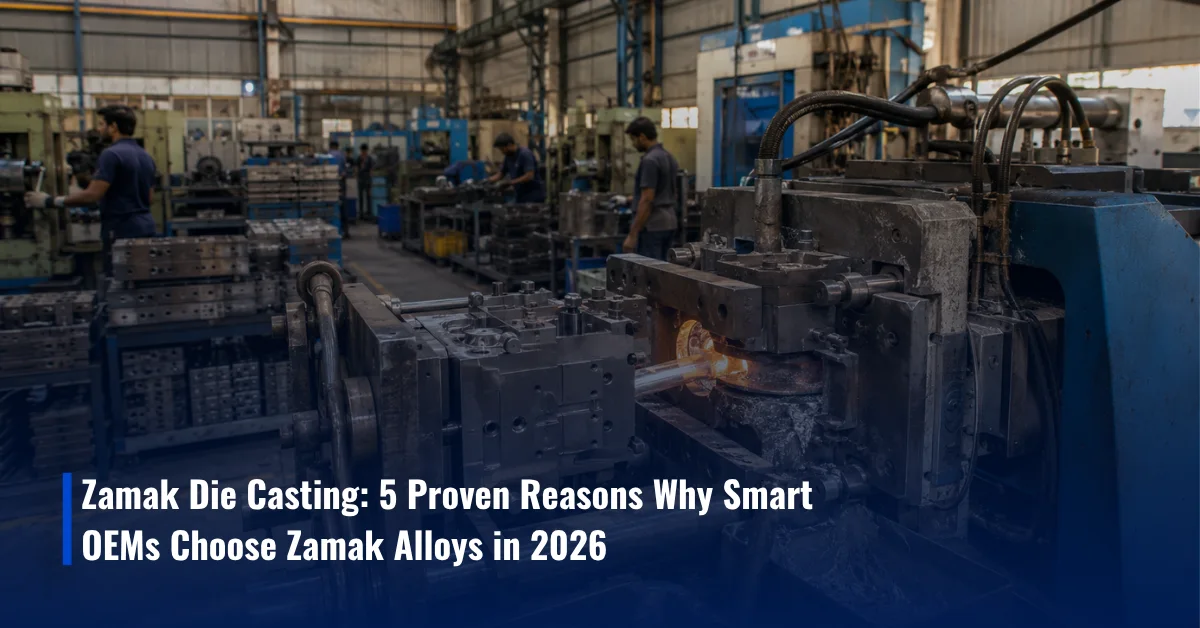
Zamak die casting is a high-pressure metal casting process where a zinc-based alloy — Zamak — is melted and injected into a hardened steel mold at pressures between 150 and 350 bar. The alloy fills the cavity in milliseconds, solidifies rapidly, and ejects as a near-net-shape component needing minimal secondary work.
The name Zamak comes from the German words for its four elements: Zink + Aluminium + Magnesium + Kupfer (Copper). Zinc forms 94–96% of the alloy. The remaining elements are precisely controlled to tune strength, castability, and surface quality for specific applications.
What makes Zamak uniquely suited to die casting is its low melting point — approximately 420°C — which enables the use of hot-chamber machines. Unlike cold-chamber aluminium die casting, where molten metal is ladled separately into the machine for each shot, hot-chamber machines keep the injection system permanently immersed in the melt. The result is faster cycle times, better process consistency, and lower energy consumption per component.
Zamak 3, Zamak 5, and ZA-8: Choosing the Right Grade
Not every application needs the same alloy. Three grades dominate industrial Zamak die casting:
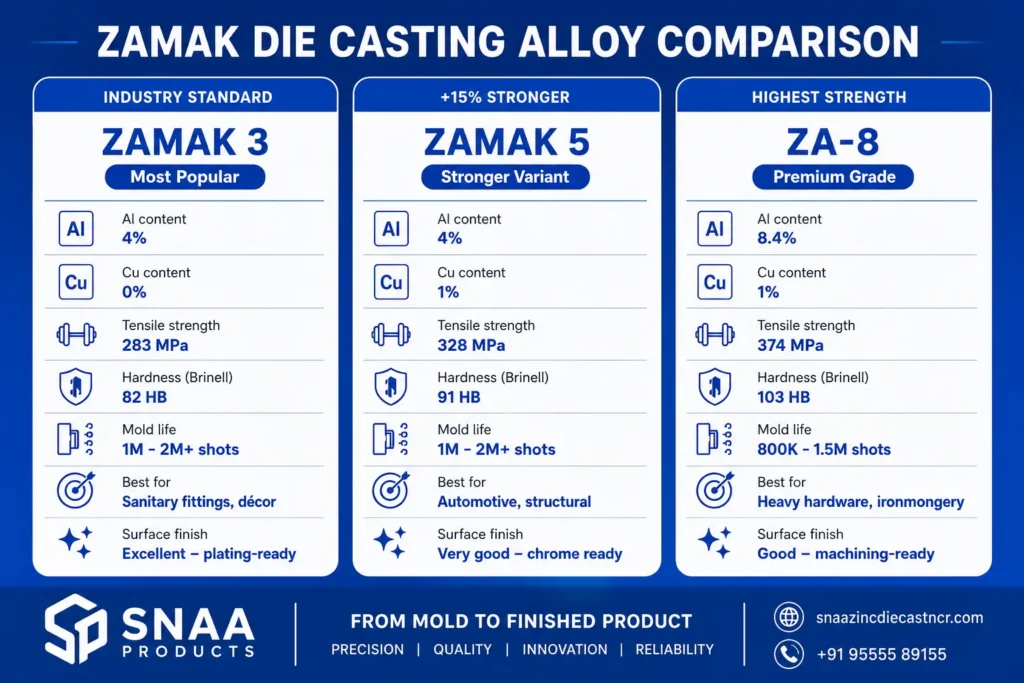
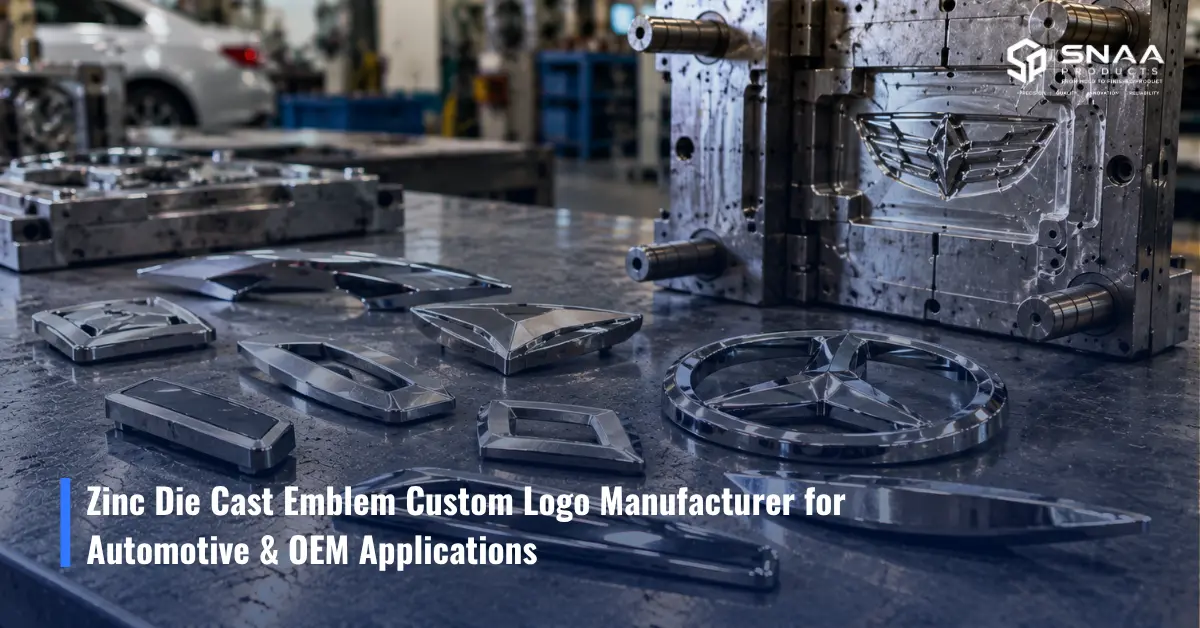
Zamak 3 is the most widely used — roughly 70% of global Zamak production. With near-zero copper content, it delivers outstanding castability, excellent ductility (10% elongation), and the smoothest as-cast surface finish of any Zamak grade. It is the standard specification for sanitary hardware, furniture fittings, toys, and decorative components where chrome plating or PVD is the final finish.
Zamak 5 adds approximately 1% copper to the base formula. This single change increases tensile strength by about 15% (from ~280 MPa to ~328 MPa) and hardness by roughly 10%. The trade-off is slightly reduced ductility — Zamak 5 elongation drops to 7%. It is the preferred grade for automotive components, pneumatic fittings, and structural hardware that carries mechanical load in service.
ZA-8 takes aluminium content to 8.4%, delivering the highest strength and hardness among hot-chamber-castable zinc alloys. It is specified for heavy-duty architectural ironmongery and industrial structural components where load-bearing capacity is the primary requirement.
5 Reasons OEM Buyers Keep Choosing Zamak in 2026
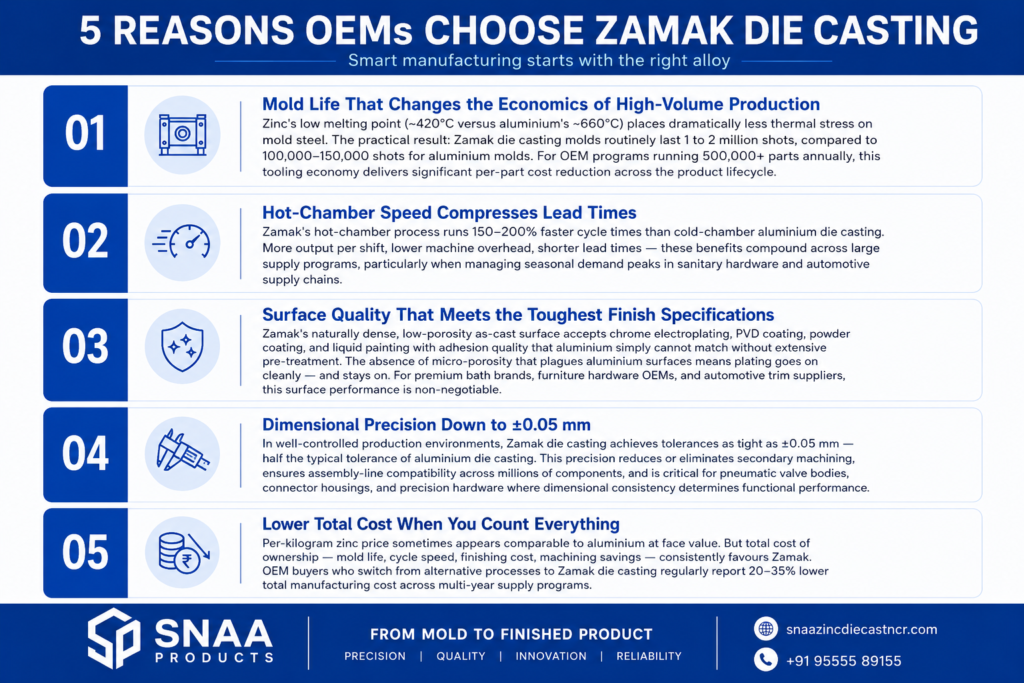
1. Mold Life That Changes the Economics of High-Volume Production
Zinc’s low melting point (~420°C versus aluminium’s ~660°C) places dramatically less thermal stress on mold steel. The practical result: Zamak die casting molds routinely last 1 to 2 million shots, compared to 100,000–150,000 shots for aluminium molds. For OEM programs running 500,000+ parts annually, this tooling economy delivers significant per-part cost reduction across the product lifecycle.
2. Hot-Chamber Speed Compresses Lead Times
Zamak’s hot-chamber process runs 150–200% faster cycle times than cold-chamber aluminium die casting. More output per shift, lower machine overhead, shorter lead times — these benefits compound across large supply programs, particularly when managing seasonal demand peaks in sanitary hardware and automotive supply chains.
3. Surface Quality That Meets the Toughest Finish Specifications
Zamak’s naturally dense, low-porosity as-cast surface accepts chrome electroplating, PVD coating, powder coating, and liquid painting with adhesion quality that aluminium simply cannot match without extensive pre-treatment. The absence of micro-porosity that plagues aluminium surfaces means plating goes on cleanly — and stays on. For premium bath brands, furniture hardware OEMs, and automotive trim suppliers, this surface performance is non-negotiable.
4. Dimensional Precision Down to ±0.05 mm
In well-controlled production environments, Zamak die casting achieves tolerances as tight as ±0.05 mm — half the typical tolerance of aluminium die casting. This precision reduces or eliminates secondary machining, ensures assembly-line compatibility across millions of components, and is critical for pneumatic valve bodies, connector housings, and precision hardware where dimensional consistency determines functional performance.
5. Lower Total Cost When You Count Everything
Per-kilogram zinc price sometimes appears comparable to aluminium at face value. But total cost of ownership — mold life, cycle speed, finishing cost, machining savings — consistently favours Zamak. OEM buyers who switch from alternative processes to Zamak die casting regularly report 20–35% lower total manufacturing cost across multi-year supply programs.
Where Zamak Die Casting Is Actually Used
Zamak serves a remarkably diverse application base:
Sanitary & Bathware — Faucet bodies, mixer valve components, showerhead assemblies, urinal actuators. Zamak 3 is standard here; its surface quality drives the chrome and PVD finishes these products demand.
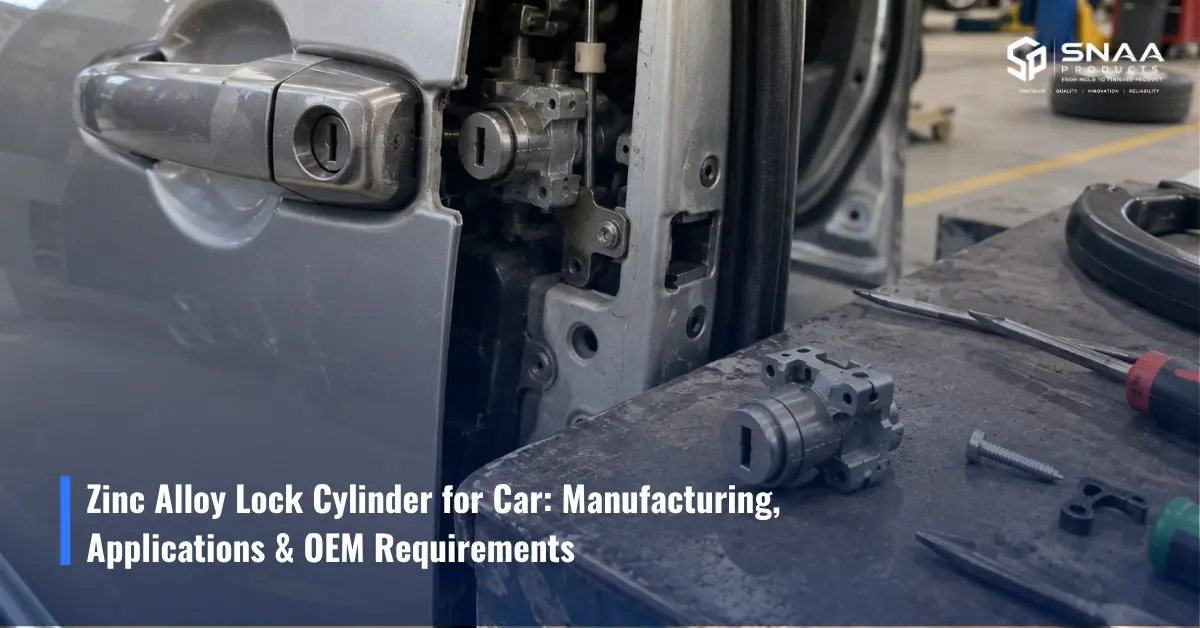
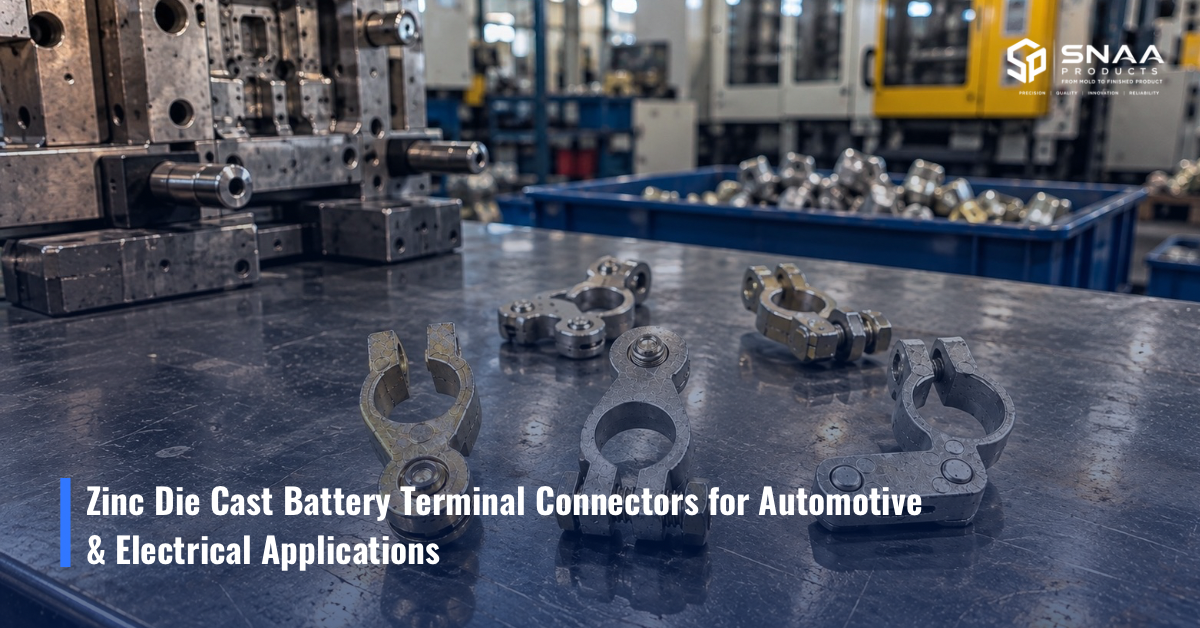
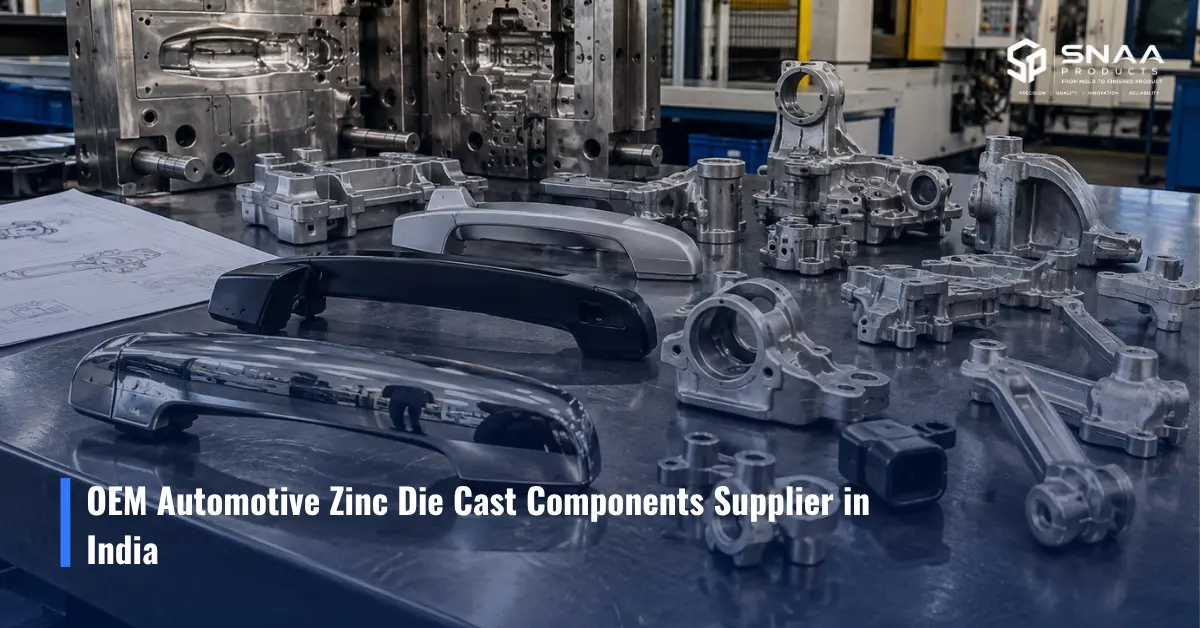
Automotive & Electricals — Brake levers, indicator housings, connector bodies, chrome-plated decorative trim. Zamak 5 for load-bearing parts; Zamak 3 for cosmetic components.
Furniture, Hardware & Architectural — Cabinet pulls, door lever sets, window hardware, hinges. Both grades used depending on load requirements.
Pneumatic & Gas Line Components — Valve bodies, actuator housings, precision fittings. Dimensional accuracy and casting integrity are the critical requirements.
Toys — Die-cast vehicle bodies, gear mechanisms, structural frames. Zamak has been the toy industry standard for decades — safe, durable, and capable of fine detail at high volume.
Zamak vs Alternatives: The Numbers That Matter
| Parameter | Zamak | Aluminium | Brass |
|---|---|---|---|
| Melting Point | ~420°C | ~660°C | ~900°C |
| Mold Life | 1M–2M shots | 100K–150K shots | 50K–100K shots |
| Cycle Speed | Fastest | Moderate | Slow |
| Tolerance | ±0.05 mm | ±0.10 mm | ±0.15 mm |
| Surface Finish | Excellent | Good | Very Good |
| Chrome Plating | Excellent compatibility | Difficult | Good |
What to Actually Verify Before Choosing a Zamak Manufacturer
Quality claims are easy to make. These are the specific things worth verifying:
- Spectro Report — Alloy composition verified by spectrometer for every batch. Zamak is sensitive to trace impurities; without batch-level verification, there is no assurance the casting matches the specified grade.
- Salt Spray Test — For chrome-plated components, insist on documented neutral salt spray test results (ASTM B117 / ISO 9227). A minimum of 96–100 hours without base metal corrosion is the industry benchmark for sanitary and hardware applications.
- ISO 9000 / 9001 Certification — Confirms a documented quality management system is in place across all production stages.
- Raw Material Traceability — Petro report and material report documenting the source and composition of incoming zinc material.
- Dedicated Tool Room — Mold design, manufacturing, and maintenance handled by the same team doing the casting eliminates the quality gaps that arise when tooling is outsourced.
At SNAA Products, every Zamak production batch is backed by Hindustan Zinc-sourced material, spectrometer analysis, petro and material reports, and 100-hour salt spray certification for chrome-plated components — under an ISO 9000-certified quality system, from our Sonipat, Haryana facility.
Is Zamak Die Casting the Right Choice for Your Program?
If your components are small-to-medium in size, require tight tolerances, carry a decorative or functional surface finish, and need consistent high-volume supply — Zamak die casting is almost certainly your best manufacturing option. It outperforms aluminium on surface quality and mold economics, outperforms brass on speed and cost, and outperforms steel on castability and finishing compatibility.
The question is not whether Zamak is the right material. For most hardware, sanitary, automotive trim, pneumatic, and toy applications, it is. The question is whether your manufacturing partner has the alloy verification, quality documentation, and process control to deliver that performance consistently. Contact SNAA products today!