- Home
- Services
- Prototyping
Rapid Prototyping Services in Delhi NCR
SNAA Products provides Rapid Prototyping Services in Delhi NCR to help manufacturers turn digital product designs into physical prototypes before committing to production tooling. Our 3D plastic prototyping process allows customers to review the physical shape, fit, form and functionality of a component and make necessary design decisions before moving ahead with the final mold or die.
3D Prototyping for Product Development
A digital CAD model can show how a component should look, but a physical prototype provides a much clearer way to evaluate the actual form and design.
Our 3D plastic prototyping process converts approved digital designs into physical samples that can be reviewed before production tooling begins. This creates an important validation stage between digital design and manufacturing.
Rapid prototyping is widely used to create physical models quickly from digital designs, helping teams test concepts, identify design issues and make changes before investing in production tooling.
Why Use Rapid Prototyping?
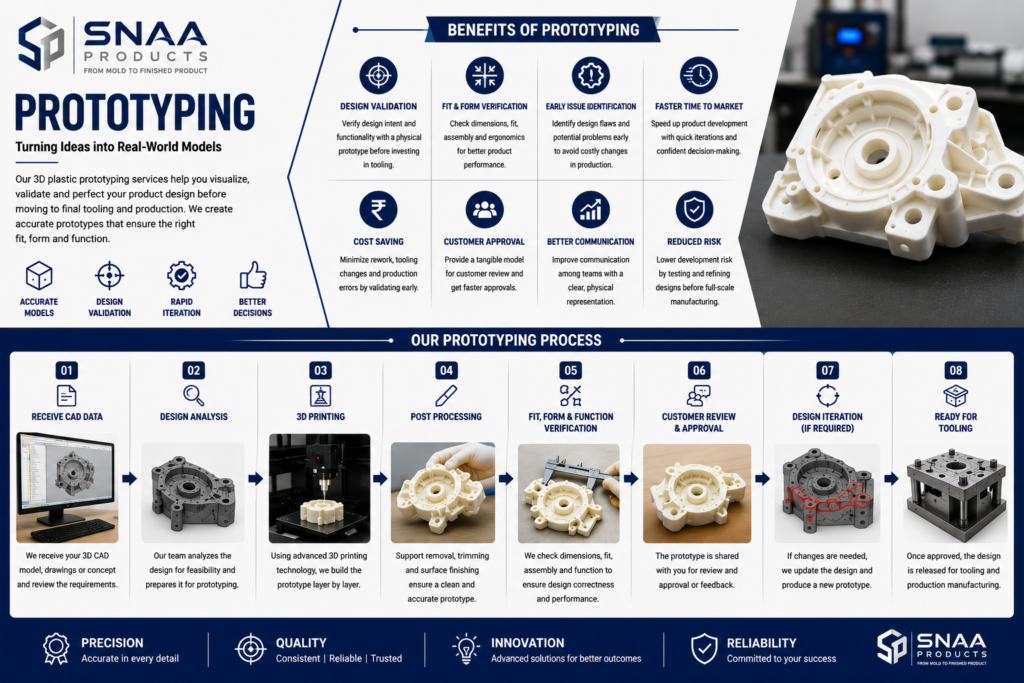
Prototyping helps reduce uncertainty before a component moves into expensive production tooling. A physical prototype allows designers, engineers and customers to examine the actual component rather than relying only on drawings or digital models.
Key benefits include:
- Faster Design Validation
- Physical Fit and Form Verification
- Early Identification of Design Issues
- Faster Design Iterations
- Reduced Tooling Risk
- Better Customer Communication
- Improved Product Development
- Smoother Transition to Production
Creating and testing prototypes before final tooling can help identify required changes earlier in the development cycle, reducing the risk of expensive modifications after production tooling has been manufactured.
Our 3D Plastic Prototyping Process
Our prototyping workflow is designed to connect product design with final manufacturing.
Step 1: 3D CAD Design Review
The process begins with the customer’s 3D CAD model, technical drawing, product specification or design requirement.
The digital model is reviewed to understand the component geometry and prepare it for prototype development.
Step 2: 3D Plastic Prototype Development
A physical 3D-printed plastic prototype is produced from the approved digital design.
The prototype provides a tangible representation of the proposed component and allows the design to be evaluated before moving to steel tooling. This approach supports rapid design iterations and physical validation.
Step 3: Fit, Form and Function Verification
The physical prototype can then be evaluated for:
- Overall shape
- Dimensions
- Fit
- Form
- Design details
- Assembly compatibility
- Functional requirements
This stage helps identify potential design changes while the project is still in the development phase.
Step 4: Customer Review and Approval
The prototype is presented to the customer for review.
The customer can physically inspect the sample and provide feedback or request design modifications. Once the prototype meets the required expectations, customer approval is obtained before proceeding to the next manufacturing stage.
The customer approval stage is part of SNAA Products’ established mold development workflow.
Step 5: Design Modification and Iteration
If changes are required, the digital design can be updated and another prototype can be produced for review.
This iterative approach allows design decisions to be made before production tooling, where modifications can be considerably more involved.
Step 6: Transition to Tooling
Once the prototype is approved, the finalized design can proceed toward production tooling.
For SNAA Products’ tooling workflow, the approved prototype moves into the tool room, where H13 die steel is selected and the mold manufacturing process begins.
Rapid Prototyping for Die Casting Projects
For die casting projects, prototyping is particularly useful before committing to the final mold.
The prototype provides an opportunity to review the component’s physical geometry and design intent before the tooling stage. This creates a controlled transition from:
CAD Design → 3D Plastic Prototype → Customer Approval → Tool Manufacturing → Trial → Production
SNAA Products follows this prototype-led approach as part of its broader mold designing and manufacturing workflow.
Applications of 3D Prototyping
Our 3D Prototyping Services can support product development across multiple industries, including:
- Automotive Components
- Electrical Components
- Hardware & Furniture Components
- Healthcare Components
- Power Tool Components
- Agricultural Components
- Telecommunication Components
- Sanitary & Bathroom Products
- Industrial Components
- Consumer Products
A physical prototype can be especially useful when component geometry, assembly, appearance or functionality needs to be reviewed before production.
Prototyping for Custom Components
Every product has different design requirements. Our prototyping process can work from:
- 3D CAD files
- Technical drawings
- Product samples
- Component specifications
- Customer concepts
- Design modifications
The objective is to create a physical representation that helps the customer and manufacturing team evaluate the proposed component before final tooling.
From Prototype to Production
Prototyping is not the final manufacturing stage. It is a critical development step that helps bridge the gap between a digital design and production-ready tooling.
Once the prototype is approved, the project can move into mold or die manufacturing. SNAA Products’ tooling workflow includes H13 die steel preparation, CNC and VMC machining, die fitting and alignment, trial production, sample inspection and final production release.
This creates a connected development process from the first digital design through physical validation and final production tooling.
Why Choose SNAA Products for Prototyping?
SNAA Products integrates prototyping with its broader tooling and component manufacturing capabilities.
Our prototyping approach provides:
- 3D plastic prototype development
- Physical design validation
- Fit and form evaluation
- Customer approval stage
- Design iteration support
- Direct transition to tooling
- Integrated mold manufacturing capabilities
- CNC and VMC machining support
- Final mold trial and production release
This means the prototype is developed as part of the wider manufacturing process rather than as an isolated model.
EXCELLENT Based on 9 reviews
 Posted on Google
 Sumedha VermaThe quality of the custom zinc die casting components supplied by SNAA Products was excellent. Every part matched our specifications, and the surface finishing was flawless. We look forward to working with them again.Posted on Google
 Sachin AnandWe required tool and die manufacturing along with zinc die casting under one roof. SNAA Products handled everything professionally, from mold development to final inspection. A dependable manufacturing partner.Posted on Google
 aditi aroraWe have worked with several pressure die casting manufacturers, but SNAA Products stands out for consistent quality, responsive customer support, and timely deliveries. Highly recommended for industrial manufacturing needs.Posted on Google
 rajni guptaWe were looking for a reliable zinc die casting manufacturer in Delhi NCR, and SNAA Products exceeded our expectations. The quality of the zinc die casting parts, timely delivery, and professional support made the entire process smooth. Highly recommended for OEM projects.Posted on Google
 Isha GuptaWe sourced custom zinc die casting parts from SNAA Products for our hardware business. The machining, chrome plating, and finishing quality were outstanding. Great service and competitive pricing.Posted on Google
 Deepak KumarSnaa products is one of the best precision zinc die casting manufactures we have worked with their team understood our technical requirements perfectly and delivered high quality components with excellent dimensional accuracy .Posted on Google
 Arusha RahejaHigh quality and durable products with remarkable services. The explanation about every product was insightful and detailed, helping us to carve the best possible decisions.Posted on Google
 arihant aroraPosted on Google
 Simran kanwarVerified by TrustindexTrustindex verified badge is the Universal Symbol of Trust. Only the greatest companies can get the verified badge who has a review score above 4.5, based on customer reviews over the past 12 months. Read more





Trusted by 100+ Customers
FAQ
What is rapid prototyping?
Rapid prototyping is the process of quickly creating a physical model from a digital design so that its form, fit, function and design can be evaluated before production.
What type of prototype does SNAA Products make?
SNAA Products’ documented workflow includes producing a 3D-printed plastic prototype for physical verification before steel tooling.
Why is a 3D prototype made before mold manufacturing?
A prototype allows the design to be physically reviewed and approved before moving to the steel tooling stage, helping identify changes earlier in development.
Can the prototype be modified?
Yes. If the physical sample identifies a required design change, the digital design can be modified and another prototype can be developed for review.
Request a Free Consultation
Share your requirement — our technical team will respond within 24 hours