When an automotive buyer searches for high pressure zinc die cast auto parts, they are rarely looking for a generic explanation of zinc casting.
They are usually trying to answer much more practical questions:
Can the supplier manufacture my part accurately? Can the die survive production? Can the casting handle secondary machining? Can the supplier maintain batch-to-batch consistency? And can one manufacturing partner take the component from tooling to a finished, assembly-ready part?
That is where high pressure zinc die casting becomes interesting.
Zinc alloys are particularly suited to high-pressure die casting because they can fill complex die cavities quickly and produce detailed, repeatable components. The process can also support integrated bosses, holes, ribs and other features that may otherwise require additional assembly operations. NADCA identifies high-speed production, dimensional stability, complex geometries and finishing compatibility among the key advantages of die casting.
For automotive applications, however, high pressure zinc die cast auto parts are not simply about putting molten zinc into a mould. The quality of the final component is determined long before the first production shot.
What Are High Pressure Zinc Die Cast Auto Parts?
High pressure zinc die cast auto parts are automotive components produced by injecting molten zinc alloy into a reusable steel die under high pressure.
The pressure forces the metal into detailed sections of the cavity before rapid solidification. The resulting component can approach its final geometry directly from the die, reducing the amount of material removal required afterward.
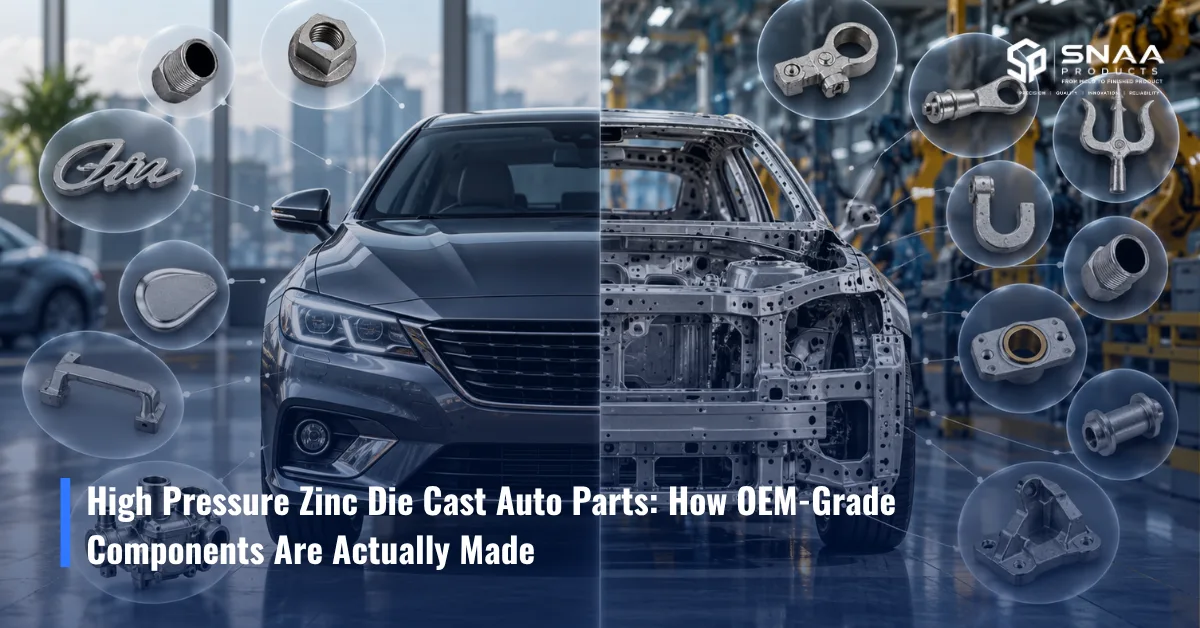
This is particularly useful for automotive components such as:
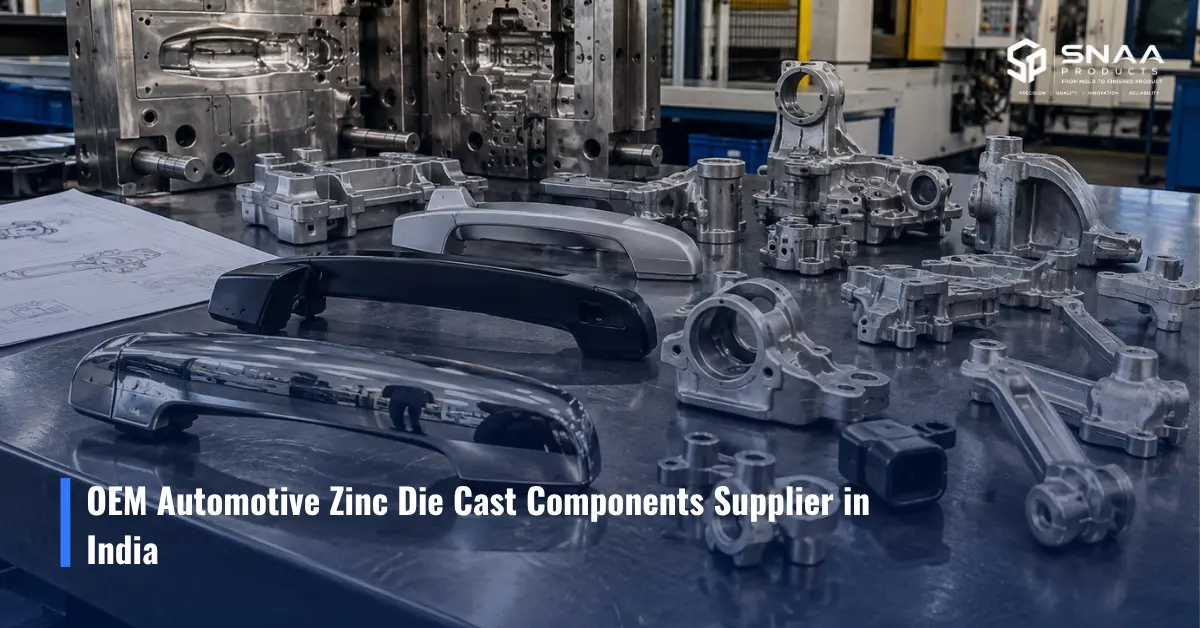
- Door handles and operating mechanisms
- Brackets and mounting components
- Lock and latch components
- Automotive levers
- Instrumentation components
- Headlight bezels
- Seat-belt hardware
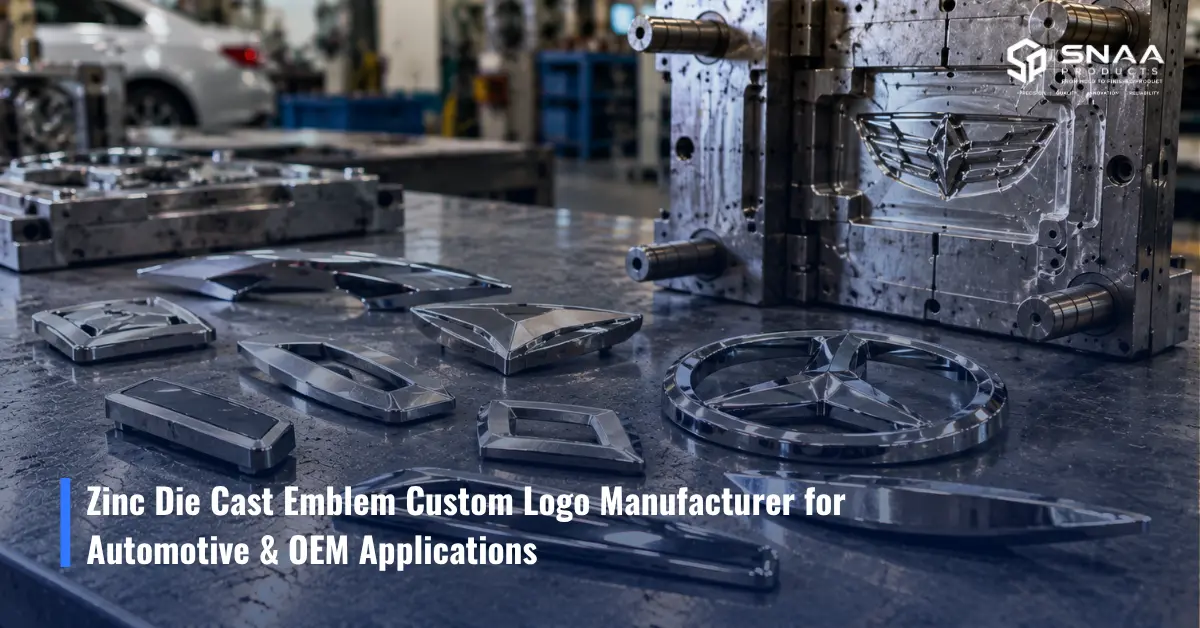
- Emblems and decorative components
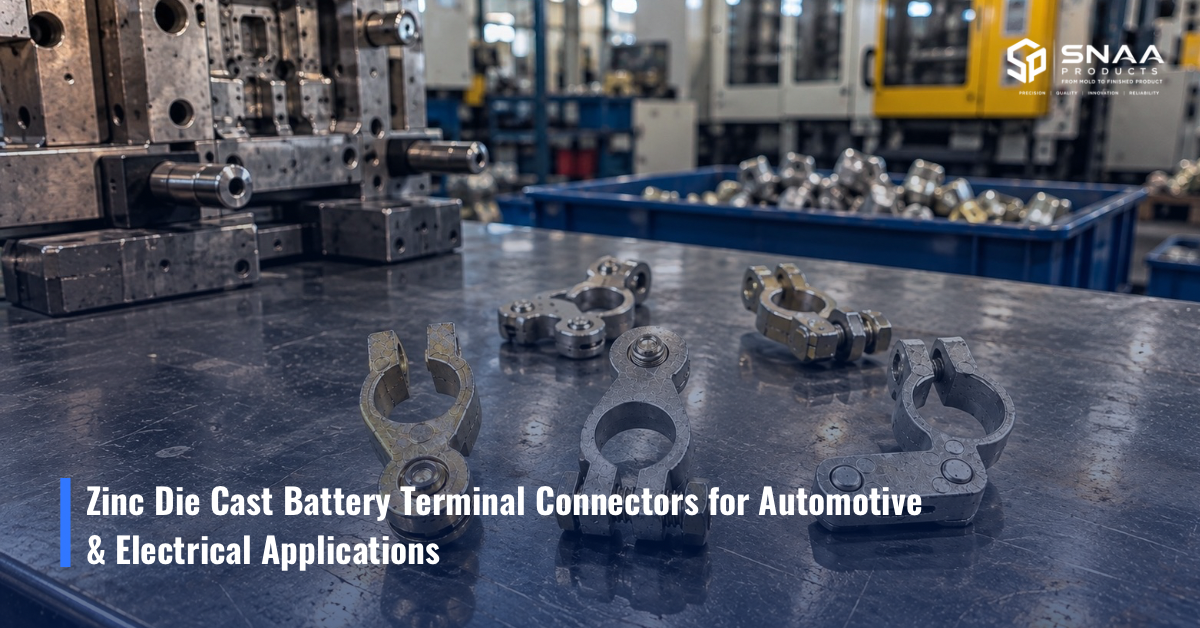
- Electrical housings
- Connector and mounting components
- Fuel-system-related hardware
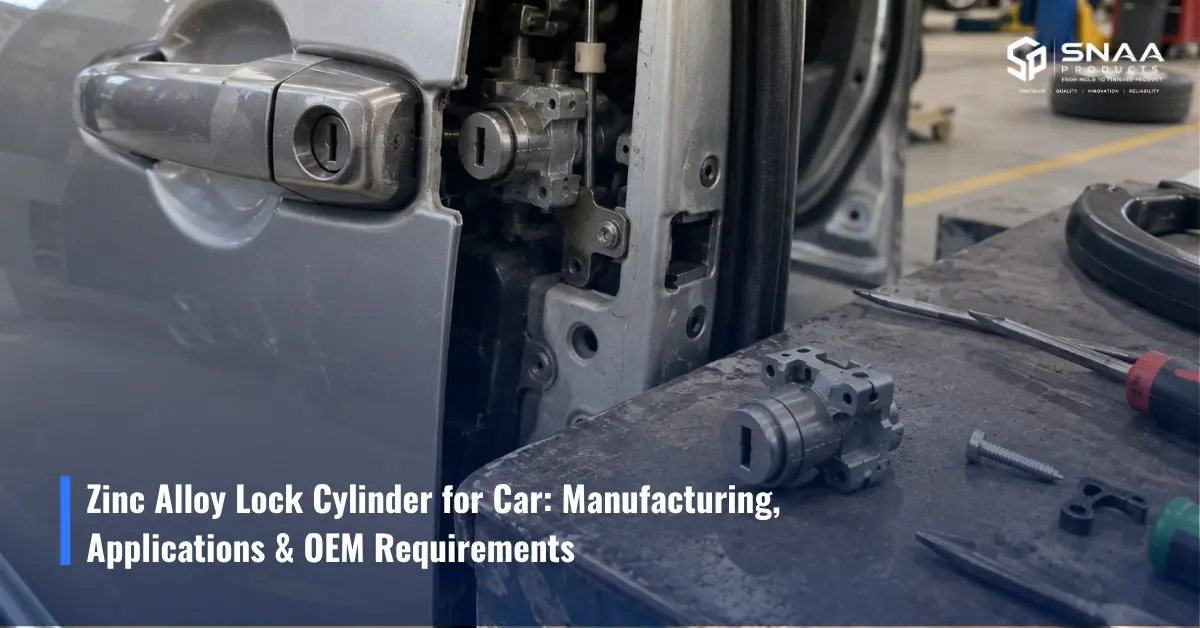
SNAA Products’ current automotive portfolio includes door handles, carburetor components, headlight bezels, seat-belt buckles, brackets, emblems, lock cylinders and other zinc die cast automotive components.
Why Automotive Engineers Choose Zinc
The interesting part about high pressure zinc die cast auto parts is that zinc is not selected merely because it is easy to cast.
It can solve several manufacturing problems simultaneously.
Complex geometry
Zinc die casting can reproduce relatively intricate shapes, allowing designers to incorporate features directly into the component.
Dimensional repeatability
For high-volume automotive production, repeatability is often more important than achieving one excellent prototype.
A part that measures correctly once but varies between batches is not useful to an OEM.
Surface finish
Zinc has excellent compatibility with plating and other finishing processes. NADCA specifically notes that zinc die castings can be produced with smooth or textured surfaces and are readily plated or finished.
Tooling economics
Zinc’s relatively low melting temperature places less thermal stress on dies than higher-melting-point alloys, contributing to long tooling life under suitable production conditions.
That combination makes high pressure zinc die cast auto parts attractive for components where geometry, appearance and repeatability matter together.
How SNAA Manufactures a Zinc Automotive Part
This is where the difference between a casting supplier and an OEM-oriented manufacturing partner becomes visible.
At SNAA Products, the production route begins with the customer’s drawing, CAD data, sample or technical specification, rather than simply starting at the casting machine. The company provides custom OEM zinc components and has an in-house tool room for mould development.
The manufacturing route can be understood in six stages.
1. Engineering and Part Review
Before tooling, the component is evaluated for manufacturability.
Important considerations include:
- Wall thickness
- Draft
- Parting line
- Critical dimensions
- Ribs and bosses
- Machining allowances
- Thread requirements
- Ejection
- Gate and overflow strategy
NADCA’s die-casting guidance similarly emphasizes appropriate wall thickness, draft and radii when designing die-cast components.
For high pressure zinc die cast auto parts, this stage can determine whether the final production process will be stable or troublesome.
2. Tool and Die Manufacturing
Once the component design is finalized, the production die becomes the next critical asset.
SNAA maintains an in-house tool room and mould-development capability, giving the manufacturing team control over tooling development, maintenance and production coordination.
This matters because automotive tooling isn’t simply a cavity with the shape of the component.
It has to manage:
metal flow → filling → cooling → solidification → ejection → repeatability.
A poor die design can create problems that later appear as flash, dimensional variation, filling issues or unnecessary machining.
3. High Pressure Die Casting
This is where the component actually takes shape.
Zamak is particularly compatible with hot-chamber zinc die casting. In the hot-chamber process, the injection mechanism remains associated with the molten metal, enabling rapid production cycles for suitable zinc alloys. NADCA describes zinc as well suited to hot-chamber die casting because of its melting characteristics.
SNAA manufactures high pressure zinc die cast auto parts using Zamak 3 and Zamak 5 alloys depending on the application.
The choice between the alloys should be driven by the component’s actual requirements rather than by a generic preference.
For example:
Zamak 3 can be attractive where castability, dimensional stability and surface quality are important.
Zamak 5 provides higher strength and hardness than Zamak 3 and can therefore be considered for applications with greater mechanical demands.
The correct grade ultimately depends on the drawing, loading conditions, geometry and finishing requirements.
4. Trimming and Secondary Machining
The component coming out of the die is not necessarily the component that goes directly onto an automobile.
It may still require:
- Drilling
- Tapping
- Thread cutting
- Turning
- Pitch-control machining
- Other precision machining operations
SNAA specifically lists drilling, tapping, inner and outer thread cutting, pitch-control machining and turning among its post-production capabilities.
This is an important consideration when sourcing high pressure zinc die cast auto parts.
The casting supplier should understand the final assembly requirement—not just the casting itself.
For example, if a threaded mounting point has a critical fit, the engineering team needs to determine whether the thread should be cast, machined or partially formed in the casting and finished afterward.
5. Surface Finishing
Automotive components are often judged visually as well as mechanically.
Depending on the component, SNAA offers:
- Chrome electroplating
- Nickel plating
- PVD gold
- Powder coating
- Zinc plating
- Shot blasting
- Sand blasting
- Vibratory media finishing
The company lists 8+ finishing options as part of its integrated production capability.
This is particularly relevant for high pressure zinc die cast auto parts used in visible automotive hardware.
A casting that is dimensionally correct but cannot consistently achieve the specified finish is still a production problem.
6. Inspection Before Dispatch
Automotive production doesn’t leave much room for random variation.
SNAA’s published quality workflow includes inspection at multiple stages, including incoming material, in-process dimensions, pre-finishing inspection and final inspection.
For high pressure zinc die cast auto parts, inspection can cover:
- Critical dimensions
- Hole locations
- Thread dimensions
- Part weight
- Surface condition
- Flash
- Casting defects
- Finish quality
- Assembly interfaces
The inspection plan should ultimately be tied to the customer’s drawing and critical-to-function characteristics.
How Much Production Capacity Does SNAA Have?
This is one area where serious B2B buyers should be careful with supplier marketing.
SNAA publicly describes its capability as high-volume, bulk manufacturing and states that it serves 100+ customers, with more than 30 years of manufacturing experience.
However, SNAA’s current public website does not publish a fixed number of die-casting machines, individual machine tonnages or a single tonnes-per-month production figure.
And that distinction actually matters.
A die-casting machine’s clamping tonnage is not the same thing as tonnes of finished parts produced.
Production output depends on:
part weight × number of cavities × cycle time × machine availability × uptime × rejection rate.
For an OEM project, the meaningful capacity question is therefore not simply:
“How many tons can the factory produce?”
It is:
“Can the supplier consistently run this specific part, with this shot weight, cavity configuration, cycle time and annual volume?”
That is the conversation an automotive sourcing team should have before awarding a program.
What Makes SNAA Relevant for Automotive OEM Supply?
SNAA Products was established in 1996 and operates from its manufacturing facility in Bawana, Delhi. It is ISO 9001:2015 certified and has more than 30 years of zinc die-casting experience.
Its current manufacturing offering brings several stages together:
Tool room → mould development → zinc die casting → machining → finishing → inspection
rather than treating each stage as a completely separate supplier relationship.
For an OEM, that can simplify communication around engineering changes, tooling modifications, machining requirements and finished-part specifications.
SNAA also manufactures zinc components for automotive and electrical applications, including brackets, door handles, headlight bezels, seat-belt components, lock-related parts and electrical enclosures.
The company has been manufacturing zinc components since 1996, so its automotive capability is built on an established manufacturing operation rather than a recently added product category.
What Should You Send a Zinc Die Casting Manufacturer?
If you’re an automotive procurement or engineering team evaluating high pressure zinc die cast auto parts, sending only a photograph of the component is rarely enough.
A proper RFQ should ideally contain:
2D manufacturing drawing
With dimensions, tolerances, datums and critical characteristics.
3D CAD model
Preferably the latest revision.
Annual requirement
The supplier needs to understand the expected production volume.
Material requirement
Specify the required zinc alloy where already defined.
Surface finish
Chrome, nickel, powder coating, PVD or another specified finish.
Machining requirements
Identify holes, threads, bearing/assembly surfaces and other post-casting requirements.
Quality documentation
Specify inspection reports, material documentation and other PPAP or customer-specific requirements where applicable.
The better the engineering information supplied at the beginning, the more accurately the manufacturer can evaluate tooling, machine suitability, cycle time and production economics.
Why the Manufacturing Process Matters More Than the Keyword
Anyone can write high pressure zinc die cast auto parts on a webpage.
The more useful question is:
What happens after the customer presses “Send RFQ”?
At a serious manufacturing operation, the journey should look something like this:
Drawing/CAD → DFM review → Tool design → Die manufacturing → Trial casting → Process correction → Production casting → Trimming → Machining → Surface finishing → Inspection → Packing → Repeat supply
That is the real manufacturing story behind high pressure zinc die cast auto parts.
And it is also where supplier capability becomes measurable.
SNAA Products: From Zinc Casting to Assembly-Ready Automotive Components
SNAA Products has built its zinc die-casting operation around custom OEM manufacturing rather than only standard catalogue components.
With 30+ years of manufacturing experience, Zamak 3 and Zamak 5 capability, an in-house tool room, pressure die casting, machining and multiple finishing options, the company can support automotive components through multiple stages of the production lifecycle.
For companies sourcing high pressure zinc die cast auto parts, the value is not simply getting a zinc casting.
It is getting a component developed around the actual automotive application.
Conclusion
High pressure zinc die cast auto parts make sense when automotive manufacturers need a combination of complex geometry, repeatability, surface quality and scalable production.
But the casting machine is only one part of the equation.
The final component depends on:
engineering → tooling → alloy → casting → machining → finishing → inspection.
SNAA Products brings these stages together from its Bawana, Delhi facility, with a manufacturing history dating back to 1996 and capabilities covering tooling, Zamak 3 and Zamak 5 casting, post-casting machining and multiple surface finishes.
For an automotive OEM, the right supplier conversation therefore starts with the part drawing and production requirement, not simply the price per kilogram of zinc.
Frequently Asked Questions
1. What are high pressure zinc die cast auto parts?
They are automotive components produced by injecting molten zinc alloy under high pressure into a reusable steel die to create repeatable, detailed components.
2. Which zinc alloys does SNAA Products use?
SNAA Products primarily manufactures custom components using Zamak 3 and Zamak 5, selected according to application requirements.
3. Can SNAA manufacture automotive parts from a CAD drawing?
Yes. SNAA states that it manufactures custom components according to customer drawings, CAD files, samples and technical specifications.
4. Does SNAA provide machining after zinc die casting?
Yes. Its published post-production capabilities include drilling, tapping, inner/outer thread cutting, pitch-control machining and turning.
5. How long has SNAA Products been manufacturing zinc die cast components?
SNAA Products was established in 1996 and currently states that it has 30+ years of manufacturing experience. Its facility is in Bawana, Delhi.