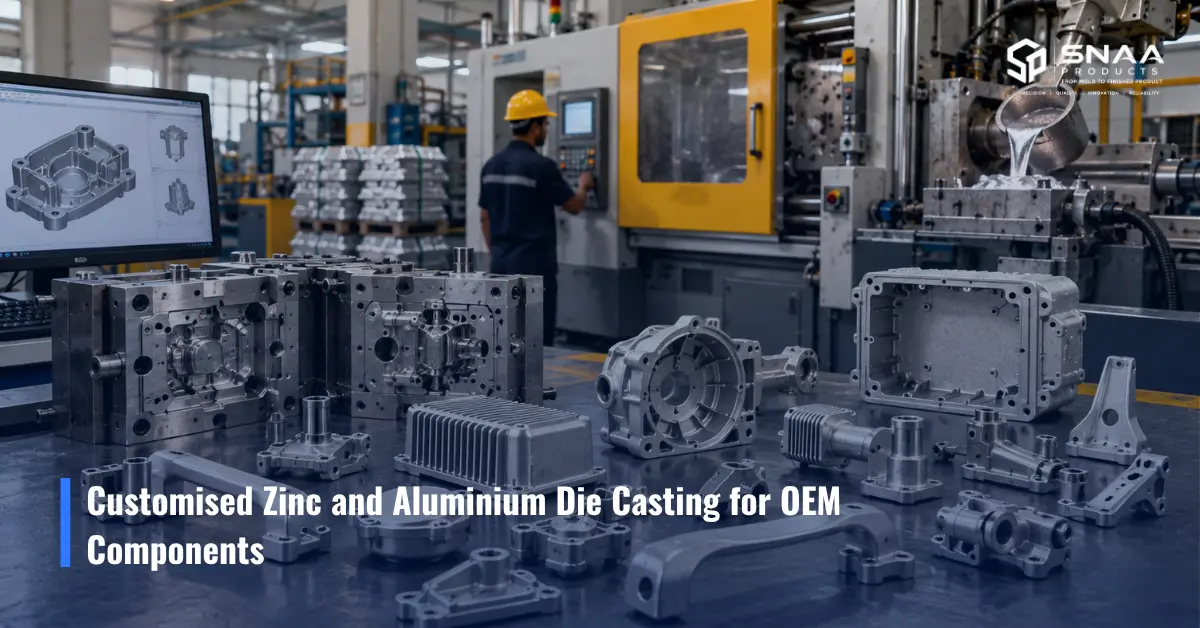
When an OEM needs a metal component with repeatable dimensions, complex geometry and consistent production quality, Customised Zinc and Aluminium Die Casting can provide an efficient manufacturing solution.
Successful die casting is not simply about selecting a machine and producing a component. Material selection, component design, tooling, machine capacity, machining, surface finishing and inspection all need to work together.
For manufacturers sourcing Custom Zinc & Aluminium Die Casting Components, this integrated approach can turn an engineering drawing or CAD model into a production-ready component.
What Are Custom Zinc & Aluminium Die Casting Components?
Custom Zinc & Aluminium Die Casting Components are components manufactured according to a customer’s engineering drawing, CAD model, sample or technical specification.
The material can be selected according to the application’s requirements, including:
- Component weight
- Mechanical requirements
- Geometry and wall thickness
- Dimensional accuracy
- Thermal requirements
- Surface finish
- Production volume
- Machining requirements
This makes Customised Zinc and Aluminium Die Casting particularly useful for OEMs requiring repeatable components rather than standard catalogue parts.
Zinc or Aluminium: Which Material Is Right?
The right material depends on what the component needs to achieve.
Zinc alloys such as Zamak 3 and Zamak 5 are suitable for detailed components where dimensional accuracy, surface quality and complex geometry are important.
Aluminium is often selected where lightweight construction, useful mechanical strength, corrosion resistance, dimensional stability and thermal conductivity are important.
Therefore, Custom Zinc & Aluminium Die Casting Components should be specified according to the actual application rather than simply selecting the most commonly used alloy.
For Customised Zinc and Aluminium Die Casting, material selection should ideally be considered during the engineering and design stage.
How Are Custom Die Cast Components Manufactured?
A production-ready component normally moves through several stages.
1. Design and DFM
The process begins with an engineering drawing, CAD model or approved sample.
Wall thickness, draft angles, radii, parting lines, machining allowances, gates, vents and ejection requirements can be evaluated before tooling begins.
Good Design for Manufacturability (DFM) can help identify potential production problems before they become expensive tooling modifications.
2. Tool and Mould Development
The mould is developed around the component geometry and production requirements.
For Customised Zinc and Aluminium Die Casting, tooling is a critical production asset. Its design can influence filling behaviour, repeatability, dimensional consistency and production efficiency.
3. Die Casting
The selected alloy is melted and injected into the die under controlled pressure to reproduce the required component geometry.
4. Trimming and Machining
After casting, the component may require trimming and deburring. Depending on the design, additional operations can include drilling, tapping, threading, turning and other machining processes.
5. Surface Finishing
The required surface treatment is selected according to the application and appearance requirements. Possible processes include polishing, plating, powder coating, painting and other specified finishes.
6. Quality Inspection
The finished component is inspected against the approved technical requirements before production or dispatch.
This complete workflow is important when producing Custom Zinc & Aluminium Die Casting Components for OEM applications.
SNAA Products’ Aluminium Die Casting Capability
SNAA Products has been manufacturing metal components since 1996, giving the company more than 30 years of manufacturing experience. Its facility is located in Bawana, Delhi NCR.
For aluminium die casting, SNAA Products operates:
- 120-ton aluminium die casting machine
- 180-ton aluminium die casting machine
- Component capability from approximately 1 gram to 1.5 kg
- Custom OEM component manufacturing
- Precision pressure die casting
- Tool and mould development
- Machining and secondary operations
- Surface finishing support
The achievable component range depends on factors such as projected area, component geometry, wall thickness, alloy, tooling design and production requirements.
This makes Customised Zinc and Aluminium Die Casting suitable for applications ranging from small precision components to larger aluminium cast components within the available machine capacity.
Applications Across Multiple Industries
SNAA Products supports Custom Zinc & Aluminium Die Casting Components for a range of industrial applications, including:
- Automotive components
- Electrical and electronics
- Industrial machinery
- Telecommunications
- Power tools
- Agricultural equipment
- Lighting
- Consumer products
- Hardware and fittings
For zinc die casting, SNAA works with Zamak 3 and Zamak 5 and manufactures components according to drawings, CAD files and samples.
For aluminium die casting, its published capability covers components up to approximately 1.5 kg, subject to component design and production requirements.
Why Tooling Matters in Die Casting
Tooling is one of the most important elements of Custom Zinc & Aluminium Die Casting Components.
A properly designed die needs to account for material flow, cooling, ejection, parting lines, draft and critical dimensions. Resolving these considerations before manufacturing the mould can reduce the risk of costly modifications later.
SNAA Products has an in-house tool room and mould manufacturing capability, with mould maintenance and refurbishment also supported in-house.
For Customised Zinc and Aluminium Die Casting, keeping tooling closely connected with production can help manufacturers maintain better control over the manufacturing process.
Machining and Secondary Operations
Casting does not always produce every feature required for final assembly.
Custom Zinc & Aluminium Die Casting Components may require accurately machined holes, threads, mounting faces or mating surfaces.
SNAA Products provides post-production operations including drilling, tapping, outer and inner thread cutting, pitch-control machining and turning.
This is particularly relevant for OEM buyers searching for a customised zinc and aluminium die casting parts manufacturer in India, as the manufacturing requirement can be evaluated beyond the initial casting stage.
Surface Finishing for Production Components
Surface finishing should be considered during the design and quotation stage rather than after casting has been completed.
SNAA Products lists finishing options including chrome electroplating, PVD gold, powder coating, nickel plating, zinc plating, shot blasting, sand blasting and vibratory media finishing for relevant components.
For Customised Zinc and Aluminium Die Casting, the selected finish can affect the manufacturing route, appearance, functionality and final component cost.
Quality Control for OEM Components
Quality inspection should not be treated as an afterthought.
SNAA Products states that its inspection process includes incoming alloy composition checks, in-process dimensional inspection, pre-finishing inspection and final inspection.
For Custom Zinc & Aluminium Die Casting Components, stage-wise inspection helps identify dimensional or surface issues before they progress further through production.
What Should You Send for a Die Casting Quote?
When sourcing Custom Zinc & Aluminium Die Casting Components, OEM buyers should ideally provide:
- 2D engineering drawing
- 3D CAD model
- Required alloy
- Component weight, if available
- Annual or batch quantity
- Critical tolerances
- Surface finish
- Machining requirements
- Application details
These details allow the manufacturer to assess tooling, machine suitability and production requirements more accurately.
For buyers searching for a customised zinc and aluminium die casting parts manufacturer in India, a complete technical brief can also make the quotation process more efficient.
Conclusion
Custom Zinc & Aluminium Die Casting Components require more than a suitable casting machine. Material selection, DFM, tooling, machine capacity, casting, machining, finishing and inspection all contribute to the final result.
SNAA Products brings these capabilities together with manufacturing experience dating back to 1996, 120-ton and 180-ton aluminium die casting machines, an approximate aluminium component range of 1 gram to 1.5 kg, in-house tooling and multiple secondary operations.
For manufacturers evaluating Customised Zinc and Aluminium Die Casting, the best starting point is a clear drawing, application requirement and expected production quantity. These details allow the manufacturing route to be developed around the actual component rather than forcing the component around a standard process.
Frequently Asked Questions
What are Custom Zinc & Aluminium Die Casting Components?
They are zinc or aluminium components manufactured according to customer drawings, CAD models, samples and technical specifications.
What aluminium die casting machines does SNAA Products have?
SNAA Products has 120-ton and 180-ton aluminium die casting machines, with an approximate component range of 1 gram to 1.5 kg, depending on component and tooling requirements.
Which zinc alloys does SNAA Products use?
SNAA Products lists Zamak 3 and Zamak 5 for its zinc die casting production.
Does SNAA provide machining after die casting?
Yes. Its published capabilities include drilling, tapping, thread cutting, pitch-control machining and turning.
Can SNAA manufacture custom OEM components?
Yes. SNAA states that it manufactures custom components based on customer drawings, CAD files, samples and technical specifications for multiple industrial sectors.