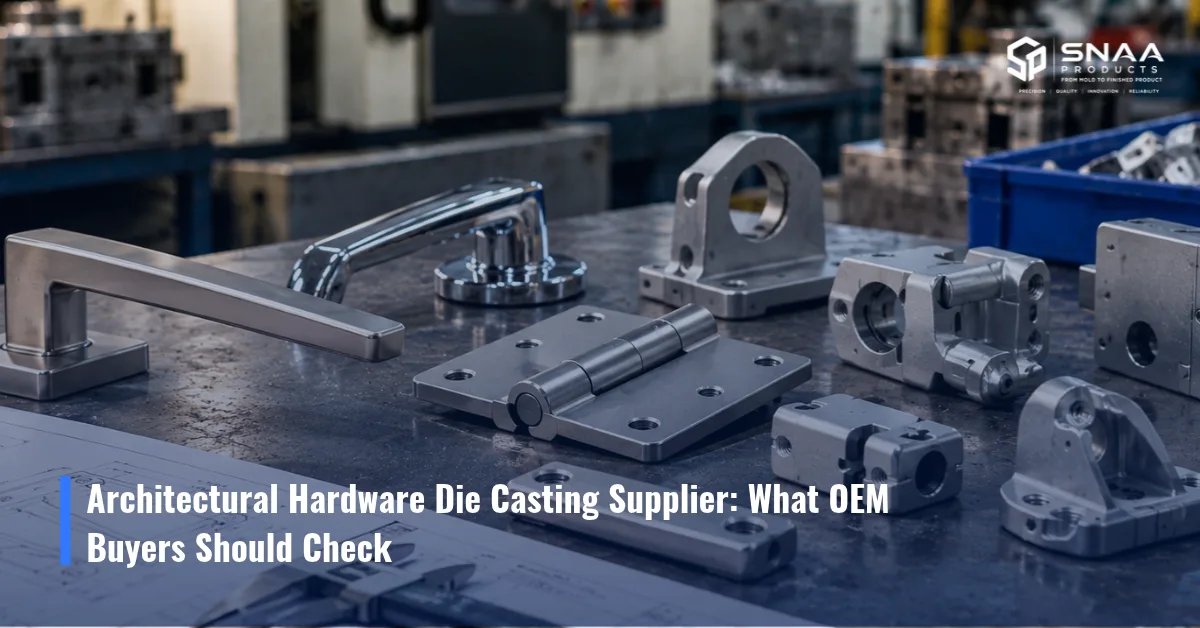
Architectural Hardware Die Casting Supplier: What OEM Buyers Should Check
Choosing an architectural hardware die casting supplier is an important decision for manufacturers of door fittings, window systems, cabinet hardware, locks, hinges and decorative metal accessories. These components must fit accurately, operate reliably and maintain their appearance through repeated use.
For OEM purchasing teams, a potential supplier should be assessed against the component specification, production needs and total project cost. Buyers should also assess alloy selection, dimensions, finishing, inspection, volumes and delivery planning.
What Is Architectural Hardware Die Casting?
Die casting injects molten metal into a shaped metal die under pressure. It can produce repeatable components with detailed shapes and consistent dimensions, particularly when production volumes justify the tooling and setup.
Zinc alloys are often considered for decorative and functional hardware because they reproduce fine details and support a range of surface finishes. Common applications include door handles, cabinet handles, knobs, hinge components, lock bodies, sliding-door rollers, brackets, connectors and decorative trim.
Working with a die casting partner early in the design review can help identify features that may affect manufacturability, finish or cost. An architectural hardware die casting supplier should consider load, wear, moisture exposure, design complexity and finish before recommending an approach.
6 Factors to Evaluate Before Choosing a Supplier
1. Component Design and Dimensional Accuracy
Hardware parts must align correctly with other components during assembly. Variations around mounting holes, threads, mating surfaces or moving features can create installation problems and increase rejection rates.
Provide engineering drawings or 3D CAD files, marking critical dimensions, tolerances and assembly interfaces. Ask how these features will be checked.
A capable architectural hardware die casting supplier should review the drawing and flag details that may affect castability, finishing or assembly before production is approved.
2. Alloy and Component Requirements
Zamak 3 and Zamak 5 are zinc alloys used for a range of die cast components. The appropriate choice depends on design, mechanical requirements, surface finish and intended service conditions. Do not select an alloy on price alone.
Explain whether the part is decorative, load-bearing, frequently handled or exposed to moisture. Share any requirements for thread strength, wear, stability or corrosion performance.
3. Surface Finishing and Appearance
Architectural hardware is often visible to the end user, so finish consistency can matter as much as dimensional accuracy. Depending on the product, finishing options may include chrome plating, nickel plating, powder coating, liquid painting, polishing, buffing or other specified treatments.
Confirm colour, gloss or texture, coating coverage and acceptable defects. Approve a representative sample or finish reference before production, especially when multiple components must match.
When comparing an architectural hardware die casting supplier with alternatives, confirm which finishes are available, what is included in the quotation and how finished parts are inspected.
4. Quality Control and Batch Consistency
A supplier should define checks for incoming material, dimensions during production, parts before finishing and finished components before dispatch. The inspection plan should reflect the risk and function of the component, not rely only on a general quality statement.
Discuss inspection records, sampling frequency and acceptance criteria. Identify critical dimensions before production. A dependable architectural hardware die casting supplier should explain the inspection approach against your drawing and risk points.
An experienced architectural hardware die casting supplier should be prepared to discuss quality requirements against the approved drawing and written specification.
5. Production Capacity and Lead Times
Explain the initial order quantity, expected repeat volume and target delivery schedule. Lead time may depend on design review, tooling arrangements, sample approval, casting, machining, finishing and final inspection.
Ask for separate estimates for first-time and repeat orders. Confirm how design changes, urgent orders and packaging will be handled.
The right architectural hardware die casting supplier should assess your expected volume and component complexity before confirming a production timeline.
6. Quotation Transparency
A useful quotation should identify the component, material, order quantity, included machining and finishing, inspection expectations, packaging, delivery terms, taxes and any separate tooling costs. Comparing only the unit price can be misleading if suppliers have quoted different scopes.
Share identical specifications with every architectural hardware die casting supplier you consider, making quotations easier to compare.
What to Include in Your Request for Quotation
A well-prepared brief helps an architectural hardware die casting supplier estimate feasibility, lead time and pricing more consistently. Prepare the following information to help a supplier evaluate the project:
- 2D drawings and 3D CAD files, if available
- Material or alloy requirements
- Initial order quantity and estimated recurring demand
- Critical dimensions, tolerances and threaded features
- Required surface finish, colour and appearance reference
- Machining and assembly requirements
- Inspection, testing and documentation expectations
- Packaging, delivery location and target dates
If the design is still under development, say so; a preliminary review may identify missing information.
Architectural Hardware Die Casting at SNAA Products
SNAA Products is a zinc die casting manufacturer based in Bawana, Delhi NCR, established in 1996. Its published hardware range includes door and cabinet handles, window handles, knobs, hinges, locks, sliding-door rollers, drawer pulls and brackets.
The company lists Zamak 3 and Zamak 5 alloys and finishing options such as chrome or nickel plating, powder coating, liquid painting, polishing and buffing. Its published setup includes four hot-chamber zinc die casting machines from 30T to 160T and a component range of approximately 0.1 grams to 1.5 kg, depending on design and process conditions.
As an architectural hardware die casting supplier for custom zinc components, SNAA Products can review drawings, CAD files or samples to discuss whether a component fits its manufacturing capabilities. Share quantity, finish, critical dimensions and target schedule for an informed feasibility review.
Learn more about SNAA Products’ zinc die cast products or visit its hardware and industry capabilities.
Frequently Asked Questions
Which architectural hardware parts can be die cast?
Examples include handles, knobs, hinges, lock bodies, sliding-door rollers, brackets, drawer pulls and decorative fittings, depending on design and performance requirements.
Which zinc alloys are used for architectural hardware?
Zamak 3 and Zamak 5 are common choices; selection depends on design and performance requirements.
What finishes are available for zinc die cast hardware?
Options may include chrome or nickel plating, powder coating, painting, polishing and buffing. Confirm availability for the specific part.
What should I send to request a quotation?
Provide drawings or CAD files, order quantity, alloy requirements, finish details, critical tolerances, inspection needs and delivery schedule. Give every architectural hardware die casting supplier the same brief so you can compare offers on a like-for-like basis.
How do I compare architectural hardware die casting suppliers?
Compare technical feasibility, quality checks, finish options, production schedule and the full quotation scope, not only the unit price.
Conclusion
A suitable architectural hardware die casting supplier should be able to explain what it can manufacture, what needs further review and which requirements could affect cost or lead time. Choosing the right architectural hardware die casting supplier requires a balance of design fit, consistent quality, appearance, production capacity and total cost. Clear drawings and agreed inspection criteria help prevent avoidable issues during sampling and repeat production.
SNAA Products manufactures zinc die cast hardware components from Bawana, Delhi NCR, and has operated since 1996. Share your component specifications to discuss suitability and request a quotation.Choosing an architectural hardware die casting supplier is an important decision for manufacturers of door fittings, window systems, cabinet hardware, locks, hinges and decorative metal accessories. These components must fit accurately, operate reliably and maintain their appearance through repeated use.
For OEM purchasing teams, a potential supplier should be assessed against the component specification, production needs and total project cost. Buyers should also assess alloy selection, dimensions, finishing, inspection, volumes and delivery planning.
What Is Architectural Hardware Die Casting?
Die casting injects molten metal into a shaped metal die under pressure. It can produce repeatable components with detailed shapes and consistent dimensions, particularly when production volumes justify the tooling and setup.
Zinc alloys are often considered for decorative and functional hardware because they reproduce fine details and support a range of surface finishes. Common applications include door handles, cabinet handles, knobs, hinge components, lock bodies, sliding-door rollers, brackets, connectors and decorative trim.
Working with a die casting partner early in the design review can help identify features that may affect manufacturability, finish or cost. An architectural hardware die casting supplier should consider load, wear, moisture exposure, design complexity and finish before recommending an approach.
6 Factors to Evaluate Before Choosing a Supplier
1. Component Design and Dimensional Accuracy
Hardware parts must align correctly with other components during assembly. Variations around mounting holes, threads, mating surfaces or moving features can create installation problems and increase rejection rates.
Provide engineering drawings or 3D CAD files, marking critical dimensions, tolerances and assembly interfaces. Ask how these features will be checked.
A capable architectural hardware die casting supplier should review the drawing and flag details that may affect castability, finishing or assembly before production is approved.
2. Alloy and Component Requirements
Zamak 3 and Zamak 5 are zinc alloys used for a range of die cast components. The appropriate choice depends on design, mechanical requirements, surface finish and intended service conditions. Do not select an alloy on price alone.
Explain whether the part is decorative, load-bearing, frequently handled or exposed to moisture. Share any requirements for thread strength, wear, stability or corrosion performance.
3. Surface Finishing and Appearance
Architectural hardware is often visible to the end user, so finish consistency can matter as much as dimensional accuracy. Depending on the product, finishing options may include chrome plating, nickel plating, powder coating, liquid painting, polishing, buffing or other specified treatments.
Confirm colour, gloss or texture, coating coverage and acceptable defects. Approve a representative sample or finish reference before production, especially when multiple components must match.
When comparing an architectural hardware die casting supplier with alternatives, confirm which finishes are available, what is included in the quotation and how finished parts are inspected.
4. Quality Control and Batch Consistency
A supplier should define checks for incoming material, dimensions during production, parts before finishing and finished components before dispatch. The inspection plan should reflect the risk and function of the component, not rely only on a general quality statement.
Discuss inspection records, sampling frequency and acceptance criteria. Identify critical dimensions before production. A dependable architectural hardware die casting supplier should explain the inspection approach against your drawing and risk points.
An experienced architectural hardware die casting supplier should be prepared to discuss quality requirements against the approved drawing and written specification.
5. Production Capacity and Lead Times
Explain the initial order quantity, expected repeat volume and target delivery schedule. Lead time may depend on design review, tooling arrangements, sample approval, casting, machining, finishing and final inspection.
Ask for separate estimates for first-time and repeat orders. Confirm how design changes, urgent orders and packaging will be handled.
The right architectural hardware die casting supplier should assess your expected volume and component complexity before confirming a production timeline.
6. Quotation Transparency
A useful quotation should identify the component, material, order quantity, included machining and finishing, inspection expectations, packaging, delivery terms, taxes and any separate tooling costs. Comparing only the unit price can be misleading if suppliers have quoted different scopes.
Share identical specifications with every architectural hardware die casting supplier you consider, making quotations easier to compare.
What to Include in Your Request for Quotation
A well-prepared brief helps an architectural hardware die casting supplier estimate feasibility, lead time and pricing more consistently. Prepare the following information to help a supplier evaluate the project:
- 2D drawings and 3D CAD files, if available
- Material or alloy requirements
- Initial order quantity and estimated recurring demand
- Critical dimensions, tolerances and threaded features
- Required surface finish, colour and appearance reference
- Machining and assembly requirements
- Inspection, testing and documentation expectations
- Packaging, delivery location and target dates
If the design is still under development, say so; a preliminary review may identify missing information.
Architectural Hardware Die Casting at SNAA Products
SNAA Products is a zinc die casting manufacturer based in Bawana, Delhi NCR, established in 1996. Its published hardware range includes door and cabinet handles, window handles, knobs, hinges, locks, sliding-door rollers, drawer pulls and brackets.
The company lists Zamak 3 and Zamak 5 alloys and finishing options such as chrome or nickel plating, powder coating, liquid painting, polishing and buffing. Its published setup includes four hot-chamber zinc die casting machines from 30T to 160T and a component range of approximately 0.1 grams to 1.5 kg, depending on design and process conditions.
As an architectural hardware die casting supplier for custom zinc components, SNAA Products can review drawings, CAD files or samples to discuss whether a component fits its manufacturing capabilities. Share quantity, finish, critical dimensions and target schedule for an informed feasibility review.
Learn more about SNAA Products’ zinc die cast products or visit its hardware and industry capabilities.
Frequently Asked Questions
Which architectural hardware parts can be die cast?
Examples include handles, knobs, hinges, lock bodies, sliding-door rollers, brackets, drawer pulls and decorative fittings, depending on design and performance requirements.
Which zinc alloys are used for architectural hardware?
Zamak 3 and Zamak 5 are common choices; selection depends on design and performance requirements.
What finishes are available for zinc die cast hardware?
Options may include chrome or nickel plating, powder coating, painting, polishing and buffing. Confirm availability for the specific part.
What should I send to request a quotation?
Provide drawings or CAD files, order quantity, alloy requirements, finish details, critical tolerances, inspection needs and delivery schedule. Give every architectural hardware die casting supplier the same brief so you can compare offers on a like-for-like basis.
How do I compare architectural hardware die casting suppliers?
Compare technical feasibility, quality checks, finish options, production schedule and the full quotation scope, not only the unit price.
Conclusion
A suitable architectural hardware die casting supplier should be able to explain what it can manufacture, what needs further review and which requirements could affect cost or lead time. Choosing the right architectural hardware die casting supplier requires a balance of design fit, consistent quality, appearance, production capacity and total cost. Clear drawings and agreed inspection criteria help prevent avoidable issues during sampling and repeat production.
SNAA Products manufactures zinc die cast hardware components from Bawana, Delhi NCR, and has operated since 1996. Share your component specifications to discuss suitability and request a quotation.