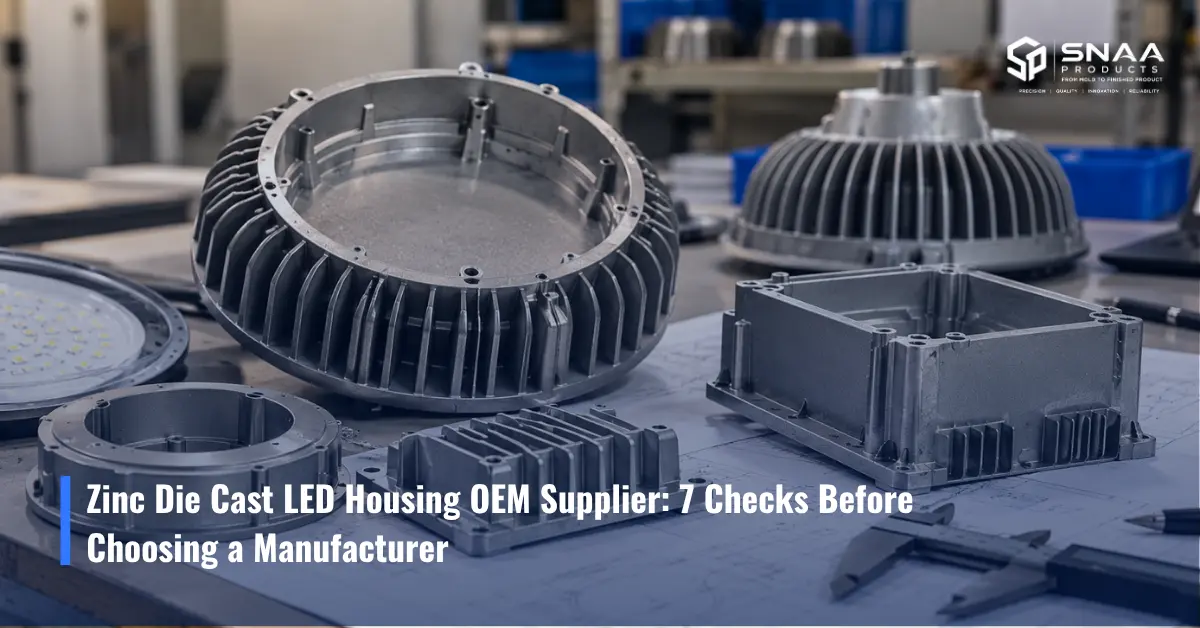
Lighting manufacturers need housings that fit accurately, support reliable assembly and meet the product’s operating requirements. Choosing a zinc die cast LED housing OEM supplier means evaluating material suitability, dimensional control, surface finishing, production consistency and total cost, not just the quoted unit price.
Zinc die casting creates intricate shapes and mounting features. Material choice depends on weight, heat dissipation and operating conditions.
SNAA Products has manufactured zinc die cast components since 1996 from Bawana, Delhi NCR. Its published capabilities include zinc pressure die casting, machining and several surface-finishing options. The suitability of a specific LED housing should be confirmed against the engineering drawing and application requirements.
What Does a Zinc Die Cast LED Housing OEM Supplier Provide?
A zinc die cast LED housing OEM supplier manufactures custom metal components to customer drawings, CAD files, samples or agreed specifications. Depending on the product, a housing may include a body, cover, mounting points, ribs, decorative features or interfaces for other lighting parts.
The housing must fit the LED board, lens, reflector, driver and bracket. Define dimensions, mounting, finish and tolerances before requesting a quotation from a zinc die cast LED housing OEM supplier.
If the housing must transfer heat, include thermal requirements in the design review. A metal housing alone does not guarantee adequate cooling; geometry, airflow and power dissipation matter.
7 Checks Before Choosing a Zinc Die Cast LED Housing OEM Supplier
1. Confirm the Material Is Suitable
Zinc alloys offer strength, dimensional accuracy and detailed shapes for selected lighting parts.
However, aluminium may be better when low weight or heat dissipation is a priority. Ask the zinc die cast LED housing OEM supplier to review temperature, thermal load, mechanical demands and environmental exposure.
SNAA Products lists Zamak 3 and Zamak 5 for custom components. A zinc die cast LED housing OEM supplier should confirm the grade against the application.
2. Review the Design Before Production
The design affects casting feasibility, dimensional repeatability, machining needs and cost. Wall thickness, draft angles, ribs, bosses, openings and parting lines should be considered before production tooling is approved.
Share a 2D drawing or 3D CAD file with critical dimensions and tolerances. Identify features requiring machining and agree how design changes will be costed.
Clarify tooling arrangements, sample development and maintenance responsibilities with the manufacturer and tooling provider.
3. Define Fit and Dimensional Requirements
An LED housing must align with lenses, reflectors, circuit boards, brackets or covers. Variations in holes, threads and mating faces can slow assembly.
A reliable zinc die cast LED housing OEM supplier should review the critical dimensions and explain how they will be inspected. Agree on the drawing revision, measurement method and acceptance criteria before approving production samples.
Identify critical fits clearly instead of applying unnecessarily strict tolerances to every feature.
4. Choose a Suitable Surface Finish
The finish affects appearance, corrosion resistance and environmental suitability. Specify requirements before production.
SNAA Products lists options including chrome electroplating, nickel plating, powder coating and liquid painting for relevant zinc die cast components. The available finish and its suitability depend on the component design and end use.
Specify colour, gloss, coating coverage and surfaces that must remain uncoated. For outdoor use, define the required performance and testing method.
5. Ask About Quality Checks
Quality requirements should be agreed before the first production batch. Depending on the design, checks may include dimensions, threads, mounting points, visible casting defects, finish consistency and fit with mating parts.
Ask the zinc die cast LED housing OEM supplier which characteristics are inspected, how often checks are carried out and how non-conforming parts are handled. Request sample inspection records where these are part of your purchasing requirements.
SNAA Products describes quality checks at different production stages. Ask the zinc die cast LED housing OEM supplier to confirm the inspection plan and available records.
6. Evaluate Production Capacity and Repeatability
A successful prototype is only the beginning. OEM buyers also need repeatable quality, realistic lead times, suitable batch sizes and clear change control.
SNAA Products publishes four hot-chamber zinc die casting machines ranging from 30T to 160T, with component sizes dependent on geometry, wall thickness, alloy and production requirements. These details can help start a technical discussion, but they do not replace a feasibility review for a particular housing.
Share annual demand, batch sizes, packaging and delivery expectations. Confirm the production schedule before setting a launch date.
7. Compare the Full Project Cost
The lowest unit price may exclude tooling, sampling, machining, finishing, inspection, packaging or transport. Compare each zinc die cast LED housing OEM supplier against the same approved drawing.
A zinc die cast LED housing OEM supplier should be given the same specification as other suppliers so that quotations can be compared fairly. Ask for tooling charges, sample costs, minimum order quantity, finishing details and estimated lead times to be listed separately where relevant.
A complete enquiry to a zinc die cast LED housing OEM supplier should include:
- Approved drawing or CAD file.
- Material and surface finish requirements.
- Critical dimensions and tolerances.
- Prototype quantity and expected annual demand.
- Inspection or documentation requirements.
- Packaging and delivery expectations.
Why Consider SNAA Products for Custom LED Housings?
SNAA Products, based in Bawana, Delhi NCR, has manufactured zinc die cast components since 1996. Published capabilities include zinc pressure die casting, machining and surface finishing. Custom components can be discussed using customer drawings, CAD files or samples.
These capabilities may suit lighting manufacturers assessing a zinc die cast LED housing OEM supplier. Confirm design, alloy, finish, tooling arrangements, capacity and thermal requirements before ordering.
For an enquiry, share the drawing, material, finish, dimensions, quantity and operating conditions through the SNAA Products website.
Conclusion
Choosing a zinc die cast LED housing OEM supplier requires clear specifications for material, design, dimensions, finish, quality checks and production planning. Zinc die casting can suit selected lighting components with complex geometry, but it is not automatically the best material for every thermal or weight requirement.
SNAA Products offers zinc die casting, machining and finishing for custom components. Contact the team to confirm feasibility against your specification.
Frequently Asked Questions
1. What information is needed for an LED housing quotation?
Provide a drawing or CAD file, dimensions, alloy, finish, tolerances, quantities and operating environment.
2. Is zinc suitable for every LED housing?
No. Material selection depends on weight, heat dissipation, operating temperature, geometry, environmental exposure and cost. Aluminium may be more suitable for some applications.
3. Can SNAA Products manufacture custom zinc die cast LED housings?
SNAA Products publishes capabilities for custom zinc die cast components. Share the design and specifications with the company to confirm feasibility for the specific LED housing.
4. Which finishes can be considered?
Published options include chrome electroplating, nickel plating, powder coating and liquid painting for relevant components. Confirm availability and suitability for the required design.
5. What affects the price of an OEM LED housing?
Cost depends on component geometry, material, tooling requirements, quantity, machining, finishing, inspection and delivery arrangements. A detailed specification supports a more accurate quotation.